Magazine · Health & Money
The quiet bill
Every year, billions are spent worldwide on pills for back pain, restlessness and sleepless nights. A Feldenkrais lesson costs a fraction of that and pursues a very different goal. What it costs, what it can offer and how to recognise a good teacher.
The BodyIQ editorial team · 8-minute read · Updated: October 2026

Photo: Thought Catalog / Unsplash
It is just after eleven at night. The second packet this month sits in the bathroom cabinet. Two pills for your back, perhaps something to help you fall asleep later. Nobody would call it an investment. And yet it is one, just one that repeats itself every month.
Hundreds of millions of people pay this quiet bill. It never appears as a separate item in the household budget because it arrives in small amounts. Together, those amounts are enormous.
The figures behind the medicine cabinet
Low back pain affected around 619 million people worldwide in 2020. By 2050, the most comprehensive analysis to date of the Global Burden of Disease study projects around 843 million people affected. No other condition worldwide takes away more years of healthy life through disability.
The market is correspondingly large. Market research firms put worldwide revenue from pain medication in 2025 at US$67–92 billion, depending on how the market is defined. Medication for anxiety disorders accounts for an estimated US$12–21 billion, and medication for sleep disorders for around US$4.5–5.5 billion. Together, that is well over US$80 billion, every year.
What the world spends on relief each year
Estimated global market in 2025, in billions of US dollars
| Pain medication | 67 – 92 |
|---|---|
| Medication for anxiety disorders | 12 – 21 |
| Medication for sleep disorders | 4.5 – 5.5 |
Ranges reflect independent market estimates. Sources: Fortune Business Insights, Research and Markets, IMARC, Towards Healthcare, 360iResearch.
Not every one of those dollars could be spent differently. The figures also include cancer pain, surgery and severe mental illness, where medication is indispensable. But a substantial share concerns complaints in which the way we sit, hold ourselves, breathe and tense our muscles plays a role: an aching back after a day at the office, a tight neck, racing thoughts at two in the morning.
In Germany alone, back problems generate direct costs of €11.6 billion a year, according to disease cost statistics. Added to that are €12.4 billion in lost production and a €21.2 billion loss in gross value added.
What the World Health Organization recommends
In December 2023, the WHO published its first dedicated guideline on chronic low back pain. It focuses on non-surgical approaches in primary care: structured exercise programmes, education and advice, and judicious use of certain medicines, such as anti-inflammatory painkillers. It explicitly advises against some medicines, including opioids in routine care. To be fair, many recommendations are based on studies with limited certainty of evidence.
The direction is clear nonetheless. Learning to move differently and handle strain differently makes you an active participant in your own care.
What Feldenkrais does differently
Feldenkrais is not treatment in the conventional sense, but a learning process. In group lessons, known as Awareness Through Movement, a teacher verbally guides you through slow, unfamiliar movement sequences. In individual lessons, known as Functional Integration, the same process takes place through gentle touch. The aim is not to switch off a symptom, but to show the nervous system new possibilities for how a movement can happen.
Research in this field is young and varied. A systematic review by the University of South Australia assessed twenty randomised studies in 2015. The results were mostly positive, but effects were often small, and the quality of many studies is limited. A controlled study from 2017 found improvements in balance, mobility and confidence among older adults.
One point remains essential: Feldenkrais does not replace medical assessment. And nobody should stop prescribed medication on their own initiative. The method is a complementary approach that works where pills cannot reach: at the level of habit.
What a lesson with an expert costs
Feldenkrais teachers set their own fees. The following ranges are examples from the German-speaking region, based on publicly advertised offers from certified teachers as of October 2026. They are not local price estimates for other countries.
What a period of Feldenkrais learning costs
Typical prices charged by certified practitioners in the German-speaking region, in euros
Per session
Large city: 120 €
| Group lesson | 18 – 28 |
|---|---|
| Individual online lesson | 60 – 90 |
| Individual lesson | 75 – 110 |
| Large city | 120 € |
Per learning period
10 group lessons
150 – 280 €
spread over around ten weeks
5 individual lessons
375 – 550 €
for a specific concern
Each practitioner sets their own prices. Guidance based on publicly advertised offers, as of October 2026. Feldenkrais complements medical treatment; it does not replace it.
- Group lesson (Awareness Through Movement), 60–75 minutes: €18–28 for a single lesson, often €15–22 per session when booked as a course or with a multi-session pass.
- Individual lesson (Functional Integration), 45–60 minutes: €75–110, rising to €120 in major cities.
- Online individual lesson: €60–90.
- Half-day workshop: €45–90.
- Switzerland: approximately CHF120–160 for an individual lesson and CHF25–35 for a group lesson.
Why the price of one lesson is the wrong question
A pill works for as long as it works. Then the bill starts again. A Feldenkrais lesson aims for something else: a skill you take with you into your next working day, your next walk, your next night.
That is why it is worth considering a period of learning rather than a single lesson. Using the German-speaking region as an example, ten group lessons cost around €150–280, spread over two and a half months. Five individual lessons cost approximately €375–550. Many teachers recommend starting with a short series and then deciding together how to continue.
Behind every lesson lies extensive training. Recognised training programmes comprise at least 800 hours over three to four years; in Germany, participants often invest €18,000 or more. What you pay for in an individual lesson is therefore not an hour of time, but years of trained perception.
Individual or group? A group lesson is an affordable, regular way to relearn movement, well suited to anyone who wants to build a routine. An individual lesson is worthwhile when you have a specific concern, when pain makes joining a group difficult, or when you want to understand more quickly what your body is habitually doing. Many people combine both.
How to recognise a good teacher
- They belong to a national Feldenkrais association and can tell you where they trained.
- In your first conversation, they ask about your concerns, your everyday life and your goals.
- They do not promise a cure and are open about the method’s limitations.
- They work with doctors or physiotherapists when necessary.
- They make fees and session duration clear before you book.
Will health insurance contribute?
Whether health insurers or supplementary insurance plans contribute to Feldenkrais, and how they do so, varies from country to country. Ask your teacher and your insurer before you book.
Back to the bathroom cabinet
The quiet bill cannot be settled overnight, and for some conditions it should not be. But you can open a second column: one that lists not packets of pills, but hours spent learning to move more easily. It is smaller than many people think. And it does not grow on its own every month.
Find a teacher near you.
Curated profiles on The BodyIQ and official association directories from 28 countries.
Find a teacherFrequently asked questions
How much does a Feldenkrais lesson cost?
As an example from the German-speaking region, a group lesson typically costs €18–28, often less when booked as a course. An individual lesson costs €75–110, rising to around €120 in major cities. Prices in Switzerland are higher.
How many Feldenkrais lessons do I need?
That depends on your concern. Many teachers recommend starting with a series of five to ten lessons and then deciding together how to continue.
Can Feldenkrais replace painkillers?
Feldenkrais is a complementary approach, not a substitute for medical treatment. Never stop prescribed medication without consulting your treating doctor.
Does health insurance cover Feldenkrais?
Whether health insurers or supplementary insurance plans contribute to Feldenkrais, and how they do so, varies from country to country. Ask your teacher and your insurer before you book.
Individual lessons or a group: which is better?
A group is suitable for regular learning at an affordable price. Individual lessons are worthwhile when you have a specific concern or when pain makes joining a group difficult.
Sources
- GBD 2021 Low Back Pain Collaborators: Global, regional, and national burden of low back pain, 1990–2020. The Lancet Rheumatology 2023 pubmed.ncbi.nlm.nih.gov
- WHO: WHO releases guidelines on chronic low back pain, 7.12.2023 who.int
- Fortune Business Insights: Pain Management Drugs Market (2025: 74,0 Mrd US$) fortunebusinessinsights.com
- Research and Markets: Pain Management Drugs – Global Strategic Business Report (2025: 67,2 Mrd US$) researchandmarkets.com
- Knowledge Sourcing Intelligence: Pain Management Drugs Market (2025: 91,6 Mrd US$) m.giikorea.co.kr
- Towards Healthcare: Anxiety Disorders Treatment Market (2025: 12,3 Mrd US$) towardshealthcare.com
- 360iResearch: Anxiety Drugs Market (2025: 20,7 Mrd US$) giiresearch.com
- IMARC Group: Global Insomnia Market (2025: 5,5 Mrd US$) imarcgroup.com
- Fortune Business Insights: Insomnia Drugs Market (2025: 4,5 Mrd US$) giiresearch.com
- WIdO / AOK: Gesundheitsatlas Deutschland – Rückenschmerzen repository.publisso.de
- Hillier S, Worley A: The Effectiveness of the Feldenkrais Method: A Systematic Review of the Evidence. 2015 pmc.ncbi.nlm.nih.gov
- Feldenkrais Movement Lessons Improve Older Adults’ Awareness, Comfort, and Function. Gerontology & Geriatric Medicine 2017 pmc.ncbi.nlm.nih.gov
- Feldenkrais Guild of North America: Becoming a certified Feldenkrais practitioner feldenkrais.com
- Feldenkrais-Ausbildung Hamburg 8, Ausbildungsinformationen feldenkraiszentrum.de
- steuertipps.de: Für diese Gesundheitskurse zahlen die Kassen steuertipps.de
This article offers orientation and does not replace medical diagnosis or treatment. Feldenkrais is movement education.
The BodyIQ Brief · once a month at most
What actually helps. Once a month.
A new piece from the magazine, a lesson to try at home and new teachers in the directory. For teachers, there's also what's working for visibility right now. No spam, one click to unsubscribe.
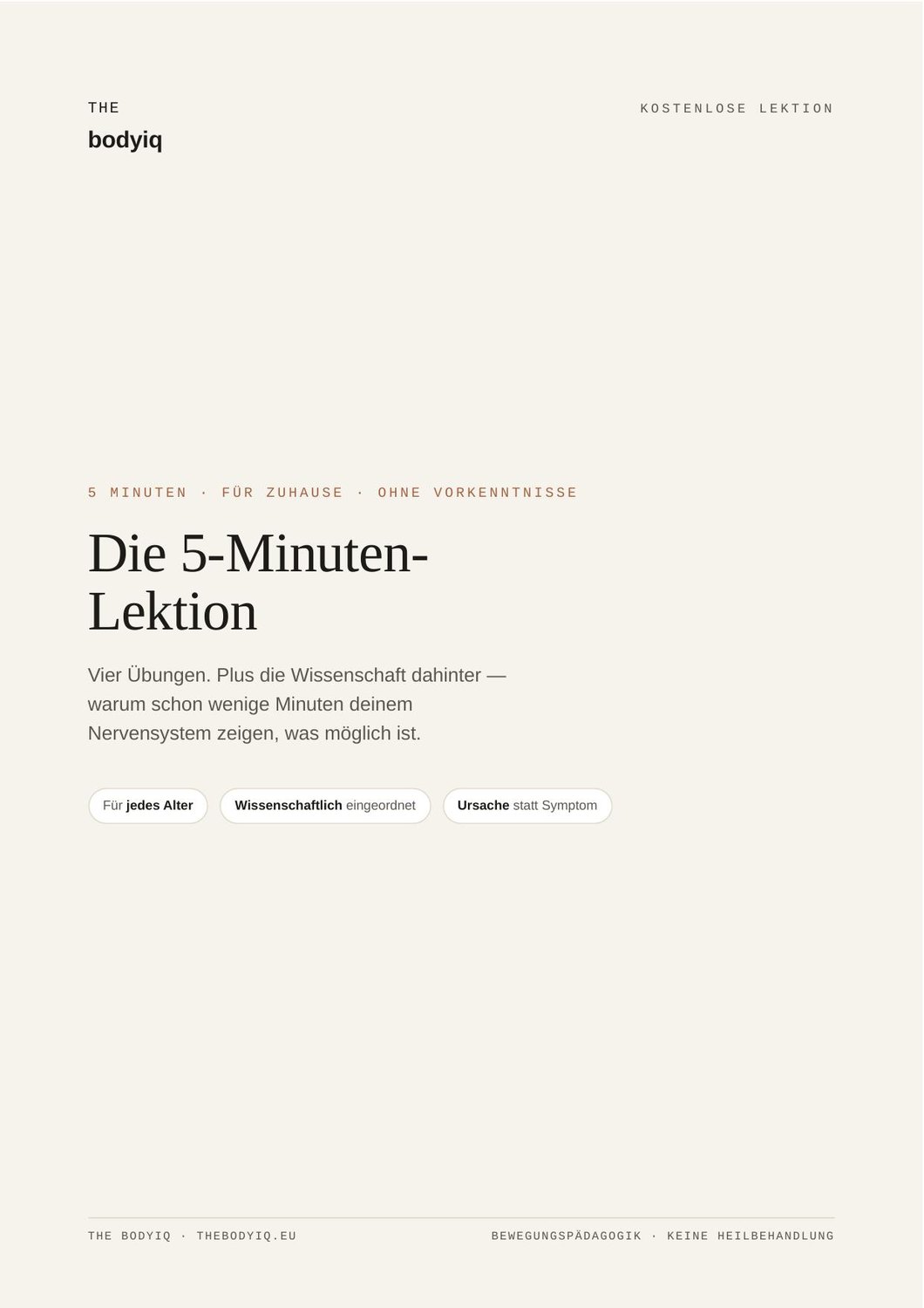
Kostenlose Lektion
Die 5-Minuten-Lektion — spür den Unterschied heute.
Vier sanfte Übungen für zuhause. Plus die Wissenschaft dahinter, warum schon wenige Minuten deinem Nervensystem zeigen, was möglich ist.