Practice
How to calm your nervous system: five body-based ways that really work.
"Just relax" doesn't work. Your nervous system doesn't listen to arguments – it listens to signals. Here are the signals it understands.
The BodyIQ editorial team · 10 October 2026 · 6 min read

You're lying in bed, your body is tired, but something keeps running. Your jaw is tight, your breath sits high in your chest, your thoughts keep jumping. That isn't a character trait or a weakness. It's a state of your autonomic nervous system – and states can change.
Not through willpower, though. The autonomic nervous system is called that because it can't be controlled directly. It responds to what the body reports back to it: breath, muscle tension, posture, gaze. That is exactly where you start.
Signs of an overactivated nervous system
- You find it hard to settle, even when there's really nothing to do.
- Your jaw, shoulders or belly are constantly tense.
- Your breathing is shallow and sits high in your chest.
- You struggle to fall asleep, or you wake in the night and are instantly wide awake.
- Small triggers – a noise, a message – set off a disproportionate reaction.
That's normal if it passes. If it becomes a permanent state, the body learns to treat tension as normal. Our topic page on the nervous system explains exactly how this works.
Five ways that work through the body
1. Breathe out for longer than you breathe in
The best-known and most thoroughly researched way. According to a meta-analysis (Laborde et al., 2022), slow breathing – around six breaths per minute – increases vagally mediated heart rate variability, a sign that the calming branch of the nervous system is gaining more influence. In practice: in for four seconds, out for six to eight.
2. Give your weight away
Lie down and notice which parts of you touch the floor. Many people keep holding themselves up even when lying down. When you consciously let your weight go into the floor, muscle tension drops – and with it the alarm signal to the brain.
3. Widen your gaze
Under stress, our gaze narrows and we focus. Let your eyes soften and take in what lies at the edges of your field of vision, without moving your head. It's no miracle cure, but for many people it's a quick way out of the tunnel.
4. Humming
A quiet, long hum lengthens the out-breath all by itself. On top of that comes the vibration in your chest and throat, which many people find pleasantly calming. To be honest about it: what's well researched is mainly the longer exhalation behind it, less so the humming itself.
5. Slow, small movement
Fast movement activates. Slow, attentive movement does the opposite: it draws your attention inwards, lowers muscle tension and slows your breathing. That is the core of the Feldenkrais Method – and the reason many people feel calmer after a class without having "practised relaxing".
The lesson: the knee pendulum – 5 minutes
The lesson
The knee pendulum
5 minLying down- Step 1
Arrive
60 secLie on your back on a mat or a rug. Bend your knees so your feet stand roughly hip-width apart. Notice which parts of you touch the floor: the back of your head, shoulder blades, pelvis, feet. Don't change anything, just notice.
- Step 2
A small pendulum
90 secLet both knees sink a little to the right and come back to the centre. Then a little to the left. The movement is so small it's almost invisible. Slowly, with no goal.
- Step 3
Notice your breath
60 secLet the pendulum keep going and observe your breathing. When do you breathe in, when do you breathe out? Let the out-breath become a little longer, without forcing it.
- Step 4
Rest
60 secLet your knees stay in the centre or stretch your legs out long. Stay lying down and notice how you feel.
- Step 5
Compare
30 secWhich parts of you touch the floor now? Is your pelvis lying differently, your back flatter, your breath deeper? Afterwards, get up slowly by rolling onto your side.
This lesson works well in the evening before sleep. If you're lying awake at night, you can also do it in bed.
How quickly does it work – and for how long?
Slow breathing and calm movement often have an effect in the moment itself. The change only becomes lasting through repetition, though. The nervous system doesn't learn safety from a single moment, but from many. A few minutes a day achieve more than one long session a week.
Frequently asked questions
How can I calm my nervous system quickly?
The fastest way is through your breath: a few breaths in which the exhalation is clearly longer than the inhalation – roughly four seconds in and six to eight seconds out. Add to that letting your weight go into the floor or the back of your chair, and widening your gaze.
Which exercises regulate the nervous system?
Slow breathing with a longer out-breath is well researched. Slow, attentive movement, contact with the floor and a soft, wide gaze can help as well. What matters is regularity, not any single exercise.
How do I stimulate the vagus nerve?
You can't deliberately "switch on" the vagus nerve, but you can strengthen its influence – above all through slow breathing with a long exhalation. Humming, calm movement and safe social contact are also mentioned in this context.
Can you calm your nervous system for good?
Yes, in the sense that its baseline state can change. The nervous system is capable of learning. If you regularly experience moments of safety and calm, you gradually shift what feels normal. That takes weeks, not days.
Sources
- Laborde S, Allen MS, Borges U, et al. Effects of voluntary slow breathing on heart rate and heart rate variability: A systematic review and a meta-analysis. Neuroscience & Biobehavioral Reviews. 2022. DSHS Köln
- Berland R, et al. Effects of the Feldenkrais Method as a Physiotherapy Tool: A Systematic Review and Meta-Analysis of Randomized Controlled Trials. International Journal of Environmental Research and Public Health. 2022;19(21):13734. doi.org
This article offers orientation and does not replace medical diagnosis or treatment. Feldenkrais is movement education.
The BodyIQ Brief · once a month at most
What actually helps. Once a month.
A new piece from the magazine, a lesson to try at home and new teachers in the directory. For teachers, there's also what's working for visibility right now. No spam, one click to unsubscribe.
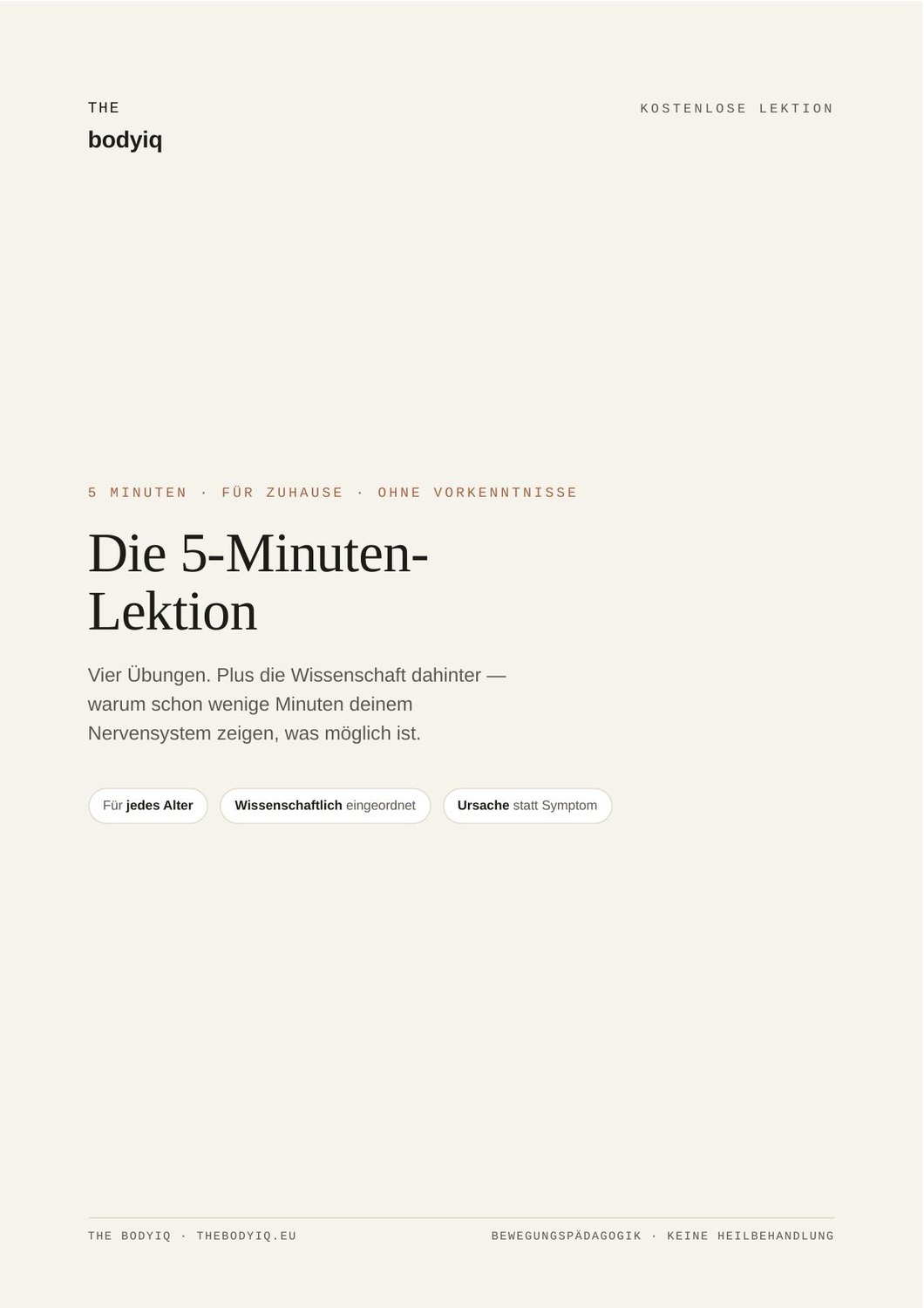
Kostenlose Lektion
Die 5-Minuten-Lektion — spür den Unterschied heute.
Vier sanfte Übungen für zuhause. Plus die Wissenschaft dahinter, warum schon wenige Minuten deinem Nervensystem zeigen, was möglich ist.